

Do you know this feeling?
You’re scrolling through your phone. There it is again – that message you’ve been meaning to send for three weeks. To your old college friend. Or to your uncle who just moved. You mean it. You want to follow through. But life gets in the way, and suddenly months have passed.
You’re not alone in this. Most of us have more people we care about than our heads can hold at once. And that’s exactly where a stay in touch app comes in. It doesn’t help you find new people – it helps you stay close to the ones who are already there.
In this article, I’ll walk you through what such an app actually does, what research says about lasting relationships, how nahbar differs from dating apps like Bumble, and what daily life with this kind of app actually feels like. No marketing fluff – promised.
What is a “stay in touch app” anyway?
A stay in touch app is a digital tool that helps you maintain contact with the people who matter to you. It reminds you to reach out. It remembers things that came up in conversation. It shows you who you haven’t connected with in a while.
The idea is simple: instead of suggesting hundreds of new profiles, this kind of app cares about the people you already know and like.
Some call it a personal CRM. The term comes from the business world – Customer Relationship Management is how companies keep track of their customers. Applied to your private life, it means keeping the people in your life within view.
A good stay-in-touch app typically does three things:
- It reminds you of birthdays, get-togethers, or simply that you haven’t heard from someone in a while.
- It collects notes about conversations, so you remember the small things next time.
- It shows you patterns – who do you feel close to, and which relationships are quietly slipping?
The goal isn’t to “optimize” relationships. It’s to be more attentive. More aware. More dependable.
Bumble and nahbar – two apps, two different worlds
If you’re thinking about how to take better care of your relationships, you may have come across dating apps like Bumble. That’s understandable – Bumble is big, well-known, and it’s about connections too.
But Bumble and nahbar solve very different problems.

Bumble is a dating and meeting app. You swipe through profiles, message strangers, hope for a match. It’s about finding new people. Bumble Bizz helps with networking, Bumble BFF with finding new friendships. But the core is the same: first contacts. Beginnings.
nahbar takes the other path. It’s not about searching, it’s about keeping. You add people who are already part of your life – family, friends, old colleagues. And nahbar helps you keep those relationships alive.
Here’s a side-by-side comparison so you can see it quickly:
| Aspect | Bumble | nahbar |
|---|---|---|
| Purpose | Meet new people | Nurture existing relationships |
| Who’s in it? | Strangers you haven’t met | People you already know |
| Main action | Swipe, message, date | Remember, take notes, follow through |
| Where is your data? | On the provider’s servers | Locally on your device |
| Need other users? | Yes – nothing happens without a match | No – the app works just for you |
| Success looks like … | A date, a match | A good phone call, a meet-up |
So, the two apps aren’t competitors. They complement each other, if anything. Bumble helps you find a beginning. nahbar helps you stay.
Why “nurturing” matters more than “finding”
There’s something dating apps rarely talk about: the hardest part of a relationship isn’t the start. It’s everything that comes after.
Falling in love, making a new friend, meeting an interesting colleague – these things often happen almost on their own. There’s a spark, a conversation, a second meeting. But six months later? A year? Five years?
Then you need something else. Less exciting, but more important: dependability.
The person who calls when you’re not okay. The person who remembers your birthday without Facebook reminding them. The person who knows your dad was sick last year and genuinely asks how he’s doing now.
Relationships like that don’t grow from grand gestures. They grow from many small ones. A voice message in between. A question that shows you were listening. An “I’m thinking of you” on the right day.
That’s where a stay in touch app helps. It takes the bookkeeping out of your head, so you can focus on what matters – being there.
What research says about relationships
You might think: nice words. But is there evidence for any of this? Yes, there is – and it’s surprisingly clear.
The longest study on happiness ever conducted
At Harvard University, a study of adult development has been running since 1938. For over 85 years, researchers have followed hundreds of people throughout their entire lives. They asked, measured, observed: what makes people happy and healthy in the long run?
The answer that today’s study director, Robert Waldinger, repeats again and again: it’s not money. It’s not success. It’s not even health alone. What keeps people content and well are good relationships.
Not the number of friends. But how warm, honest, and dependable those relationships are.
Loneliness is a health risk
In recent years, health authorities around the world have noticed something that surprised many: loneliness isn’t just a feeling. It has measurable effects on the body.
In 2023, the World Health Organization launched a commission on loneliness and declared it a global health threat. The same year, the U.S. Surgeon General Vivek Murthy formally warned of a “loneliness epidemic.”
Studies show: people who are persistently lonely have a higher risk of heart disease, dementia, and earlier death. Some researchers compare the risk to the effects of heavy daily smoking.
That sounds dramatic. And it is. But it’s also good news: if relationships have such a strong effect, then it’s worth tending to them. Even when there’s no acute crisis going on.
How many people fit into your life, anyway?
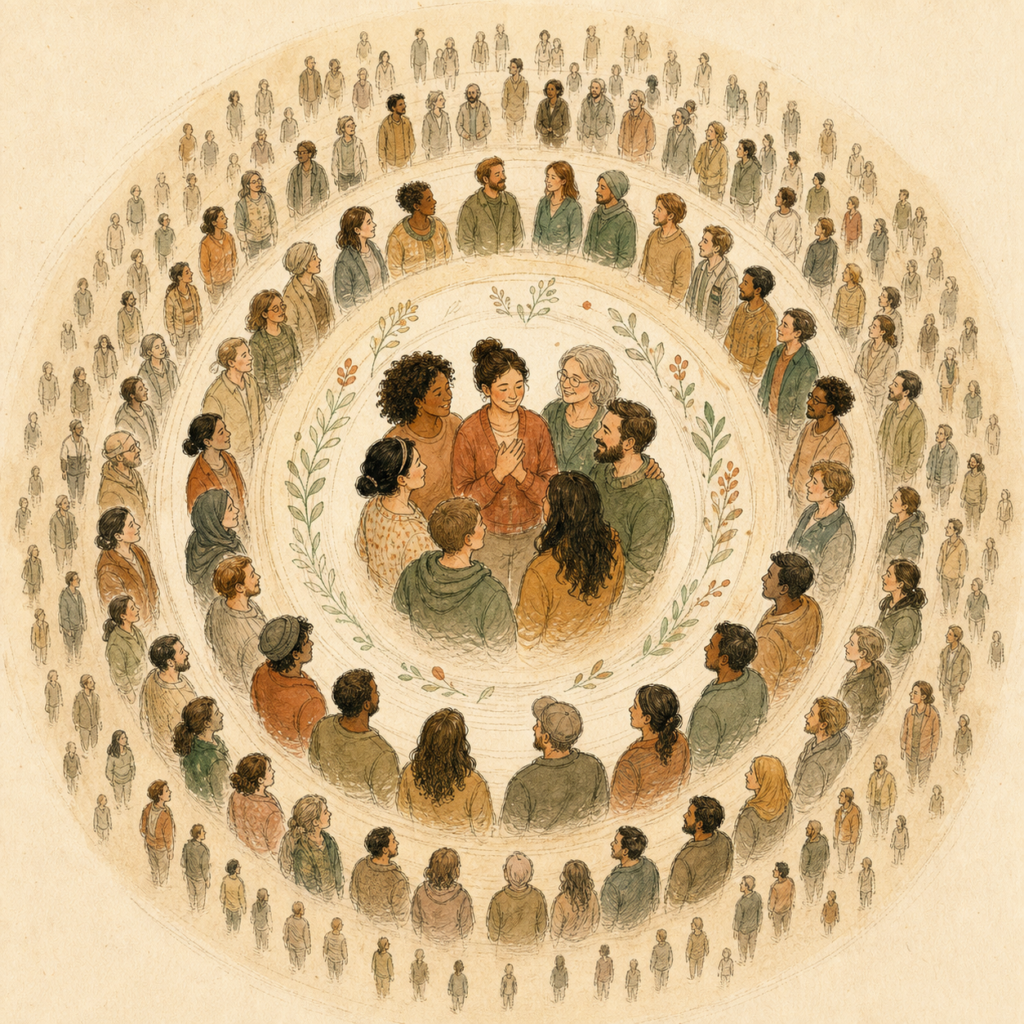
British anthropologist Robin Dunbar has spent decades asking how many relationships a single person can actually maintain. His answer is now known as “Dunbar’s number”: about 150 stable social relationships fit into the life of one human being.
But not all 150 sit on the same level. Dunbar describes several layers:
- About 5 people are especially close – immediate family, best friends
- About 15 people are close confidants you keep regular contact with
- About 50 people you know well, but less intimately
- About 150 people are stable acquaintances
What’s interesting: we can’t simply expand these numbers by collecting more profiles on some platform. Social energy is limited. Neglecting the inner layers doesn’t make us richer – even if the outer layers keep growing.
A stay in touch app can help precisely here: not by giving you more relationships, but by helping you not lose sight of the important 5, 15, and 50.
How does a stay in touch app work in everyday life?
You might be thinking: “Sounds nice, but I don’t need an app to like my friends.” True. And you don’t.
But picture this:
It’s Sunday evening. The app gently shows: “You haven’t talked to Lisa in two months.” You remember – right, you wanted to meet up, and life happened. You send a short message. Twenty minutes later, there’s a date in the calendar for next week.
Or: you’re meeting your brother. Last time he mentioned starting a new job. You forgot – but the app didn’t. Before the meeting, you see the note and can ask straight away: “Hey, how’s the new job going?”
These aren’t great technical wonders. It’s just a memory that has your back.
A good stay-in-touch app usually offers these building blocks:
Contacts with depth. Instead of just a name and number, you can add notes: what came up last time? What’s on this person’s mind right now? What do they love?
Gentle reminders. The app nudges you when too much time has passed. Not annoying, not daily. Only when it fits.
Capturing meetings and conversations. After meeting someone, you can briefly note how it went. What you talked about. Maybe even how you felt afterwards.
Overview. You see who you feel close to – and who’s been slipping out of view. Without judgement. Just a hint.
A week with nahbar – how everyday life shifts
Theory is one thing. What it actually looks like in real life is another. Let’s walk through a normal week – with Lena, 34, working in marketing, two kids. Lena feels her friends from university are slowly slipping away. Not out of bad will. Just because life is full.

Sunday evening: the gentle nudge
Lena settles on the couch. nahbar shows her in the weekly overview: “You’ve been writing a lot with your sister this week – nice. With Anna, you haven’t heard from each other for eight weeks.”
Lena thinks for a moment. True. She taps directly on Anna in the app and sends a short voice message: “Hey Anna, I was just thinking of you. Want to grab a coffee next week?”
Two minutes of effort. A relationship saved that would otherwise have continued to fade.
Tuesday: a small note that matters later
In the car on the way to work, Lena’s friend Marek calls. He talks about his mother, who has an MRI appointment coming up. He’s worried.
After the call, at the next red light, Lena briefly opens nahbar and types three sentences into Marek’s profile: “Mother has MRI on April 15th. Worried about the headaches.”
In two weeks, when she meets him again, the app will show her this note. She’ll know what to ask about. Marek will feel it – and feel seen.
Wednesday: a birthday, without Facebook
Aunt Heike has her birthday. Lena has forgotten it a few times in recent years, because Facebook no longer reminds her – she stopped using the account actively a long time ago.
This morning, nahbar sends her a reminder. She gives Aunt Heike a quick call. Five minutes of conversation. Aunt Heike is touched. “You’re the first today.”
Sometimes those are the calls people remember for years.
Thursday: after the meeting
Lena met Anna for coffee in the evening. As always, it was lovely. On the way home, she opens nahbar and makes a short note – not to evaluate, but to remember: “Anna is starting a yoga class in September. Looking for some space. Her father remains difficult.”
She marks the meeting with a small checkmark. A good feeling. Not because she “completed” something – but because she knows next time she won’t be starting from scratch.
Friday: the big picture
Over lunch, Lena scrolls briefly through the overview in nahbar. She sees: this week she had meaningful contact with the closest five people in her life. With two from the middle circle, it’s been a while. That’s okay. That’s normal. But now she knows.
She feels a little more settled in her head. Not because she ticked off a list, but because she feels she’s there for the people who need her.
What this week shows
nahbar didn’t save a single relationship for Lena. Lena did that herself. What the app did: it gave her the prompt to remember the right people at the right time.
And that’s exactly the idea behind it.
What makes nahbar different?
Before I tell you what makes nahbar special, let me be honest: there are several good apps in this space. If another one suits you better, that’s perfectly fine.
But three things matter most to us at nahbar.
Your data stays with you
Most apps store everything in the cloud, on some server, somewhere. That might not matter for a weather app. For your private relationships, it does.
With nahbar, your notes and contacts live locally on your device by default. No one else sees them. Not even us. Even if our servers disappeared tomorrow – your data would still be with you.
There’s a feature where you can ask an artificial intelligence for an opinion. That’s the only place where data leaves your device – and only if you ask for it. The app removes sensitive content beforehand. You stay in control.
Depth instead of feature stacks
Many apps grow over time. More buttons. More menus. More ways to get lost.
We try to go the other way. nahbar shouldn’t feel like a tool, but like a notebook you enjoy writing in. The most important features are clear within minutes. The rest unfolds.
Understands how you tick
Everyone tends to relationships differently. Some like to reach out daily, others need weeks of quiet. Some write long messages, others prefer short ones.
nahbar learns over time what fits you. If you like, you can answer a few questions at the start – inspired by a well-known psychological framework called the Big Five model. That helps the app give suggestions that actually fit you, instead of pressing you into a template that isn’t yours.
When do you need Bumble, when nahbar?
To make it really clear, here’s a simple guide:
Bumble makes sense when:
- You want to meet new people – romantically or as friends
- You’ve moved to a new city and want to find your tribe
- You want to build a professional network (Bumble Bizz)
nahbar makes sense when:
- You feel important people are slipping out of view
- You want to take relationships more seriously without “managing” them
- You care about privacy and don’t want your notes in the cloud
- You’re looking for a memory backup for conversations and birthdays
And yes – the two go together. You can meet someone via Bumble, and use nahbar to make sure the match doesn’t fade into silence after three months.
An app doesn’t replace a real conversation
One last important thought before you settle on any app:
A stay in touch app is a tool. Nothing more. It doesn’t call anyone for you. It doesn’t hug anyone. It doesn’t replace the honest “how are you, really?” at the kitchen table.
What it can do: clear your head. So you stop trying to remember twenty birthdays and forty life stories at once. So you get a nudge when you need one. So you feel more present, because you actually are.
If an app does that, it’s done its job. But if it stresses you out, controls you, or makes you feel you have to “process” your friendships – it’s the wrong one.
When trying any app, pay attention to how you feel using it. Lighter? More attentive? Or already stressed again? Your gut is often right here.
Frequently Asked Questions
What is a stay in touch app?
A stay in touch app is a digital tool that helps you keep up with the people who matter to you. It reminds you about birthdays, collects conversation notes, and shows you who you haven’t been in touch with for a while. Unlike dating apps like Bumble, it’s not about meeting new people but about staying close.
Is nahbar an alternative to Bumble?
Not really. Bumble helps you meet new people – nahbar helps you nurture the relationships you already have. If you want to deepen your relationships rather than have more of them, nahbar fits better. The two can also complement each other well.
Is my data safe with a personal CRM app?
That depends on the provider. Some apps store everything in the cloud, others locally. With nahbar, your data stays on your device by default – no one else has access. When choosing an app, always check where your data is stored.
Do I need an app to maintain friendships?
Honest answer: no. If your head keeps it all together – wonderful. An app helps when you notice that people are slipping out of view, even though you don’t want them to. It’s a tool, not a must.
What does nahbar cost?
nahbar comes as a free basic version, with extended features available as Pro or Max. Exact prices are on the App Store, since they can vary by region.
Does nahbar work offline?
Mostly, yes. Since your data is stored locally, you can take notes and view your contacts even when offline. Only the optional AI feature needs a connection.
Is there a nahbar for Android?
Right now, nahbar is a native iOS app, optimized for iPhone and iPad. There’s no Android version planned – we’d rather be really good on one platform than mediocre everywhere.
Can I import my existing contacts?
Yes. On first launch, nahbar can read your address book – with your permission, of course. You don’t have to type anything in by hand.
In short: be there when it matters
Bumble and nahbar serve different needs. One helps you start, the other helps you stay.
If you feel like you’re losing sight of people who really matter to you, then a stay in touch app might be what you’re looking for. Not because an app is the most important thing. But because it gives you the room to focus on what is: the people themselves.
Give nahbar a try. If it fits, we’re glad. If not, you’ve lost nothing – and maybe still thought about who you could text tonight.
That’s already something.
Ready to be there when it matters? Discover nahbar →